


Program Details

Location
Dakar,
Senegal

Term
Fall Semester
Spring Semester

Housing
Homestay

Languages Taught In
French
Program Eligibility

Student Type
Non UofM Students

Student Year
Sophomores
Juniors
Seniors

GPA
2.5

Language Prerequisite
Minimum 4 semesters college-level French
Events & Info Sessions
There are currently no events for this program. Explore more events on our events page.
Photos


About
Senegal is home to a population of more than 18 million people coming from a vast range of diverse backgrounds. These include ethnic groups, cosmopolitan peoples, and immigrants with a wide array of languages spoken and religious beliefs. This melting pot culture makes Senegal the perfect location to study human rights issues and the development of human rights policies. On this program, you will be based in Dakar, the capital of Senegal, where the blend of people can be seen on a daily basis. Study in the classroom as well as on field excursions to learn more about the unique how human rights policies are legislated at both the policy and grass roots level. You will also participate in a 6-week internship or research project to work directly with the most vulnerable populations, including but not limited to women, children, and indigenous and ethnic groups.
Housing & Meals
Homestay
You will live with a homestay family throughout your time in Senegal. If you choose an internship or research placement outside of Dakar, you will have a second homestay.
Homestay families provide breakfast and dinner daily; you will be responsible for providing your own lunches. Host families can typically accommodate a variety of dietary needs, but if you have severe food allergies and/or restrictions, you should discuss your situation with the program team prior to applying.
Homestays are an integral component of the learning experience and often a highlight for participants. Your family provides not only housing and most meals but is also a connection to Senegalese culture. Nearly all families have hosted program participants before and have been chosen for their genuine interest in sharing Senegalese life with an MSID program participant.
Excursions
Although excursions change from year to year, you can expect to visit a variety of sites that may include local markets, development organizations, and areas of interest in and around Dakar. Your human rights course will include a day-long excursion near Dakar, to bring course content to life.
A five-day academic excursion to a village in rural Senegal is considered a highlight of the semester. This takes place half-way through the classroom phase and illustrates how many of the theories learned throughout the classroom phase are put into practice.
Accessibility
If you have a disability and plan to study abroad, visit our Accessibility Abroad page to learn about considerations, answer questions, and request accommodations before you go abroad.
Flight
The Learning Abroad Center works with Village Travel, a local travel agency, to arrange a coordinated flight for program participants. The flight is optional, and is arranged for those who want to fly with other program participants. Group flight information is typically available by the program application deadline, if not before.
You will be met at the airport in Dakar (DSS). If you take the group flight, or are able to arrive just before the group flight, our staff will meet you at the airport and bring you to your arrival hotel at no added cost. If you do not take the group flight, we will arrange a taxi for you, but you will need to pay for it on your own. Specific arrival instructions will be sent out prior to your departure.
For immigration purposes, you should purchase a round-trip ticket, since you must be able to show your entry and exit dates from Senegal.
Learning Outcomes
- Foster an understanding of the global context through classroom and experiential learning
- Cultivate awareness and appreciation for critical global issues through engagement with local communities
- Translate insights gained into thoughtful and respectful long-term perspectives on concepts of social justice and sustainable development
- Strengthen communication skills through acquisition of local languages and cultural awareness
- Gain cross-cultural competencies through extended engagement at a local grassroots organization
Onsite Faculty & Staff
There are several staff members on the Human Rights in Senegal program, all of whom are there to assist you during your time in Senegal. Use them as a resource and as your first contacts for emergencies or concerns related to housing, academics, health, safety, culture shock, and much more.
Serigne Ndiaye, Ph.D.—Program Director

Serigne Ndiaye, Ph.D., is a certified Intercultural Communication facilitator and a seasoned lecturer in African Studies. He holds a pre-doctoral degree in English from Cheikh Anta Diop University and earned his Ph.D. in Comparative Literature from Emory University. After completing his doctoral studies, Serigne returned to Senegal, where he has been actively engaged in international education as both an administrator and educator. With over two decades of experience in academia and cross-cultural training, Serigne has worked extensively with both international and local students and faculty. Before joining SIT and MSID, he served as the Director of the English Language Institute in Dakar. In addition to his professional accomplishments, Serigne is multilingual—fluent in English, French, Serer, Wolof, with conversational proficiency in Spanish. Outside of his academic pursuits, Serigne enjoys spending time on the farm, embracing the tranquility of rural life.
Mohamed Gueye—Program Coordinator

Mohamed Gueye is an experienced Program Coordinator with a strong background in education and student services. He holds a Bachelor's degree in Political Science and a Master's in International relation from the University of District of Columbia (UDC). Throughout his career, Mohamed has worked closely with students from different backgrounds and academic programs, bringing a passion for community building and educational access to every role he takes on. In addition to his work in academia, Mohamed is an avid sports enthusiast who believes in the power of athletics to build discipline, leadership and teamwork - values he carries into his professional life.
Program Structure
Program Level
3000–4000 level courses
Courseload
16 credits for fall or spring semester. Add 4 credits for optional French language pre-session.
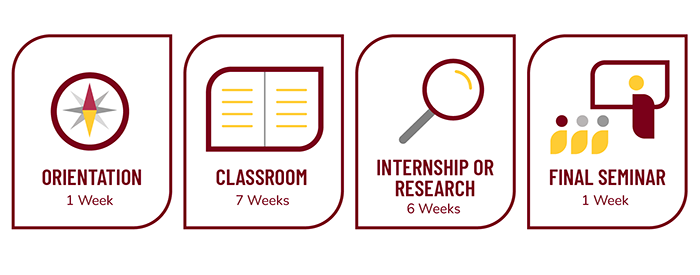
Spend seven weeks engaged in coursework in Dakar, followed by six weeks working as an intern or conducting a research project with a local grassroots organization.
Coursework
You will enroll in four required courses, including an internship or research project:
- Historical & Political Context of Senegal: You are required to enroll in this interdisciplinary course, designed to provide context to your time in Senegal.
- Human Rights Course: Understand how human rights are legislated and regulated at the policy level, as well as how they are implemented at the grass roots level. In particular, this theme will consider the impact on the most vulnerable members of society, including women, children, indigenous groups, people with disabilities, and homeless, migrant, and elderly populations.
- Language: You will select to study either French or Wolof. You will choose a course in that corresponds to your language level. All students are encouraged to study Wolof during the semester. This will help you communicate with your host families, internship/research colleagues, and navigate in and outside of Dakar. Wolof is spoken on a daily basis throughout Senegal.
- Internship or Research: You will choose to complete either an internship or a research project. The corresponding course will begin during the classroom phase and continue throughout the six weeks of your internship or research project. Your placement will correspond with the theme you chose in the International Development course.
Optional Language Pre-Session
You are encouraged to participate in the pre-session program. This intensive three weeks of French will help you bring your language skills up to speed and will provide more time to adapt to Dakar and Senegal before diving into the rigorous MSID Semester. Past participants report that the extra time in the country, and additional French language practice before tackling Wolof, was very beneficial. It enhanced their ability to understand the print and televised media, to navigate the city, and to converse with their host families and friends. The French language course is taught over three weeks and awards four undergraduate credits. Intermediate and Advanced French levels are offered.
Internships & Research Projects
The internship or research experience is the cornerstone of the MSID program. Your placement will be with an organization engaged in grassroots work related to human rights in Senegal.
During the classroom phase, the on-site staff will review your interests and attempt to place you with an organization whose goals match your objectives. Most requests within a general field can be accommodated, but adjustments may be made based on availability. You will work at least 25 hours each week.
The below will help you differentiate between an internship and a research placement.
Internships
Internships involve participation in and observation of the daily activities of a local agency. You will put into practice the theories you learned in the classroom.
- Teach computer education to youth
- Work with local art and music collectives on social justice issues
- Travel to villages to assist in conferences on violence against women, marriage, and the legal aspects of divorce in Senegal
- Work in the information and accounts departments of an organization that helps women achieve self-sufficiency
- Make children's toys from recycled materials, work in a hooking bag stand with teenagers, and teach and play music with a children's band
- Work in a day nursery at an orphanage
- Train migrant families in computers, English, and French
- Help with economic and social development planning at a regional level
- Work with organizations that help local youth groups and organizations
- Research possible solutions to problems with eco-tourism such as prostitution, higher dropout rates, and environment
Research
A research project involves a systematic investigation of a specific topic, question, hypothesis, or theory. You will conduct research under the guidance of a project supervisor from the MSID program and a local organization.
- Analyze data about the legal problems of Senegalese women at a Dakar-based women's association.
- Monitor immigration patterns, trends, causes, etc. in Senegal and West Africa
Human Subject Research
The governments of the United States and MSID countries have laws protecting human subjects of research. Due to the timeline for gaining the necessary permissions for doing research with human subjects, such research cannot be conducted while abroad on LAC program. However, there are still a wide variety of projects, that include interaction with people, that are available. See more information on options for Undergraduate Research Abroad.
Global Identity
Global Identity: Connecting Your International Experience with Your Future is an optional 1-credit online course that helps you process your international experience and apply what you've learned upon your return. Global Identity gives you the opportunity to work individually with a trained cultural mentor, helping you articulate your newly acquired skills and differentiating you from your peers.
To access more information about the course, visit the Global Identity Course Information page.
Full Course List
You will take 4 courses for a total of 16 credits. Refer to the main Academics tab for additional academic information. Below is information on course selections you will need to make when applying to the program:
- Choose one language course (either French or Wolof)
- Choose whether you will participate in an internship (SNGL 4896) or research project (SNGL 4201)
- All students will take the Historical & Political Context of Senegal course (SNGL 4101), and the Human Rights course (SNGL 4001)
Beginning Wolof
Course ID
SNGL 1101
Language
Terms
-
Fall
-
Spring
4
Credits
This Wolof course will be structured around ten competencies drawn from the Competency Based Teaching (CBT) approach. The course focuses on practical skills while emphasizing conversation and vocabulary building.
Language Taught In
- French
- Wolof
Advanced French I
Course ID
SNGL 3015
Language
Terms
-
Fall
-
Winter Break
-
Spring
-
Summer
4
Credits
This French language and grammar course focuses on advanced practical skills while emphasizing conversation and vocabulary building in the Senegalese context. This course covers linguistic skill development equivalent to 5th semester French.
Language Taught In
- French
Prerequisite
FREN 1004 or equivalent
UofM Equivalent
FREN 3015
Advanced French II
Course ID
SNGL 3016
Language
Terms
-
Fall
-
Winter Break
-
Spring
-
Summer
4
Credits
This French language and grammar course focuses on advanced practical skills while emphasizing conversation and vocabulary building. This course covers linguistic skill development equivalent to 6th semester French.
Language Taught In
- French
Prerequisite
FREN 3015 or equivalent
UofM Equivalent
FREN 3016
Intermediate Wolof
Course ID
SNGL 3101
Language
Terms
-
Fall
-
Spring
4
Credits
This course focuses on intermediate Wolof language skills including conversation, reading, and vocabulary development.
(Syllabus tailored to individual needs)
Language Taught In
- French
- Wolof
Prerequisite
2+ semesters of college-level Wolof
Advanced Wolof
Course ID
SNGL 3102
Language
Terms
-
Fall
-
Spring
4
Credits
This course focuses on more advanced Wolof conversation, reading, and vocabulary.
(Syllabus tailored to individual needs)
Language Taught In
- French
- Wolof
Prerequisite
4+ semesters of college-level Wolof
Advanced Language through Current Events
Course ID
SNGL 3201
Language
Terms
-
Fall
-
Winter Break
-
Spring
-
Summer
4
Credits
This course focuses on advanced practical speaking and listening skills while emphasizing conversation and vocabulary building through discussion of current events while living in a French-speaking country, Senegal, through language instruction and interaction with native speakers. The prerequisite is completion of 6th semester French (FREN 3016).
Language Taught In
- French
Prerequisite
FREN 3016 or equivalent
Reading & Writing through Current Events
Course ID
SNGL 3202
Language
Terms
-
Fall
-
Winter Break
-
Spring
-
Summer
4
Credits
This course focuses on advanced practical skills while emphasizing reading and writing through the analysis of works by critical Senegalese authors. The prerequisite is completion of 6th semester French (FREN 3016).
Language Taught In
- French
Prerequisite
FREN 3016 or equivalent
Human Rights, Policy, & Practice
Course ID
SNGL 4006
International Development
Terms
-
Fall
-
Spring
4
Credits
You will examine constructs of human rights and services in developing countries in general and Senegal in particular. As background to the course, we will attempt to create a common understanding of key concepts such as human rights, social justice, human services, social services, social welfare, community development, and social work. You will then look at how these ideals are implemented in Senegal and the limitations and challenges of the implementation.
Language Taught In
- French
Prerequisite
4+ semesters of college-level French
Fulfills Liberal Education Requirement
-
Global Perspectives
-
Social Sciences
Historical & Political Context of Senegal
Course ID
SNGL 4101
Historical & Political Context
Terms
-
Fall
-
Spring
4
Credits
This course provides a historical overview of Senegal and uses this rich history to explore the various political, socio-economic, and current issues that characterize Senegal today. You will analyze the place of Senegal in the broader West African sub region, discuss the physical and human resources available for Senegal’s development, and learn about the major challenges and constraints it faces while taking a critical look at the country’s economic policy and political system. The various Senegalese cultures, cultural values, arts, and lifestyles will be infused throughout the course.
Language Taught In
- French
Prerequisite
4+ semesters of college-level French
Fulfills Liberal Education Requirement
-
Historical Perspectives
Research in Senegal
Course ID
SNGL 4201
Internship or Research
Terms
-
Fall
-
Spring
4
Credits
This course will introduce you to various research concepts and practices in the research cycle and provide a forum in which you can share your research experience at each stage of the process with your peers. In this course, you will learn about making decisions involved in research regarding selection of topic and title for your study, developing statements of problems and choice of research questions, and formulating appropriate research design. Learn about issues related to research ethics, as well as develop skills in choosing data collection instruments and analysis of the data you collect for your research.
Language Taught In
- French
Prerequisite
4+ semesters of college-level French
Internship in Senegal
Course ID
SNGL 4896
Internship or Research
Terms
-
Fall
-
Spring
4
Credits
This course provides a cross-cultural experience of working on various development issues with a regional nonprofit organization. The course focuses on guiding you to understand your own identity as you integrate theory with reality by participation in local development sites. You will prepare for entering into your community work through discussions on stakeholder and agency analysis, culture specific gender and diversity context, and power and privilege. The mentoring continues while you are at your internship placement as you come in contact with social actors, community organizations, and local and national authorities. Through practical internship experiences as well as readings, discussions, and written assignments, you will deepen your understanding of the host-country cultural context, development work from an international perspective, and critically examine your own worldview.
Language Taught In
- French
Prerequisite
4+ semesters of college-level French
Global Identity
Course ID
FOST 3332/FOST 3331H
Terms
-
Online (all terms)
1
Credit
Global Identity: Connecting Your International Experience with Your Future is an optional 1-credit online course that helps you process your international experience and apply what you've learned upon your return. Global Identity gives you the opportunity to work individually with a trained cultural mentor, helping you articulate your newly acquired skills for future professional opportunities, and differentiating you from your peers.
This course is offered at no additional cost on programs 6 weeks or longer. There are several sections offered including: Honors, College of Liberal Arts, and Leadership Minor focused versions of the course. Additional details on how to request registration, deadlines, and a grade basis can be found on the Global Identity Course Information page.
Syllabus for Global Identity (FOST 3332)
Syllabus for Global Identity Honors (FOST 3331H)
Language Taught In
- English
Fulfills Liberal Education Requirement
-
Global Perspectives
Program Dates
Submit the online application and complete the assigned application checklist according to the appropriate deadline:
- Spring 2027
- Intensive French Winter Break Pre-Session + Spring 2027
- Fall 2026
- Intensive French Summer Pre-Session + Fall 2026
This program runs annually during the terms listed on the Snapshot page. Program dates are typically posted within a month of when each application cycle opens.
Orientation Dates & Locations
The Learning Abroad Center provides pre-departure orientation in preparation for your time abroad. It is your responsibility to know the information shared at these orientations.
Orientation consists of several sessions, all of which are created to support your preparation to go abroad:
- Online Health & Safety Orientation: This asynchronous module can be accessed in your LAC checklist and is mandatory.
- LAC Program Orientation: Program-specific and important UofM registration information will be covered (academic registration, finances, arrival, housing etc.). Details will be sent to you via email.
This program runs annually during the terms listed on the Snapshot page. Program dates are typically posted within a month of when each application cycle opens.
Spring 2027
Application Open Date: May 1, 2026
Application Deadline: October 15, 2026
| Schedule | Date |
|---|---|
| Depart from the US | Jan 23 |
| Arrive in Dakar | Jan 24 |
| Classroom phase | Feb 1–Mar 19 |
| Spring break | Mar 20–27 |
| Internship/Research phase | Mar 29–May 7 |
| Final seminar week | May 10–14 |
| Depart from Dakar | May 15/16 |
Intensive + Spring 2027
Application Open Date: May 1, 2026
Application Deadline: October 15, 2026
| Schedule | Date |
|---|---|
| Depart from the US | Jan 2 |
| Arrive in Dakar | Jan 3 |
| Last Day of Pre-Session | Jan 22 |
| Classroom phase | Feb 1–Mar 19 |
| Spring break | Mar 20–27 |
| Internship/Research phase | Mar 29–May 7 |
| Final seminar week | May 10–14 |
| Depart from Dakar | May 15/16 |
Fall 2026
Application Open Date: Dec 1, 2025
Application Deadline: May 1, 2026
| Schedule | Date |
|---|---|
| Depart from the US | Aug 22 |
| Arrive in Dakar | Aug 23 |
| Classroom phase | Aug 31–Oct 16 |
| Fall break | Oct 17–24 |
| Internship/Research phase | Oct 26–Dec 4 |
| Final seminar week | Dec 7–11 |
| Depart from Dakar | Dec 12 or 13 |
Intensive + Fall 2026
Application Open Date: Dec 1, 2025
Application Deadline: May 1, 2026
| Schedule | Date |
|---|---|
| Depart from the US | August 1 |
| Arrive in Dakar | August 2 |
| Last day of Pre-Session | August 21 |
| Classroom phase | Aug 31–Oct 16 |
| Fall break | Oct 17–24 |
| Internship/Research phase | Oct 26–Dec 4 |
| Final seminar week | Dec 7–11 |
| Depart from Dakar | Dec 12 or 13 |
Costs & Fees
If you do not see a budget estimate for the term you intend to go abroad, the fee has not yet been finalized. We strive to post fees for this program at least 30 days prior to the application deadline. The Learning Abroad Center will delay the posting of some fees until enrollments, inflation, and exchange rates are determined. Note the average increase in fees will be 3–10%. Program fees are based on estimates and may change depending on international economic factors.
Fees or tuition from home institutions may be added to or differ from the University of Minnesota Learning Abroad Center fees listed on this page.
Billing & Payments
Visit Billing for information about the billing process for application fees, deposits, and program fees.
Financial Aid & Scholarships
Visit Financial Information for information on using financial aid and scholarships for study abroad.
Cancellation Policy
Before you apply to or confirm your participation on this program, review the Learning Abroad Center's Cancellation Policy to inform yourself of the timeline and financial obligations for canceling.
Spring Semester 2027
MSID: Human Rights in Senegal - Standard
Fall Semester 2026
MSID: Human Rights in Senegal - Plus Intensive French
MSID: Human Rights in Senegal - Standard
Spring Semester 2026
MSID: Human Rights in Senegal - Plus Intensive French
MSID: Human Rights in Senegal - Standard
Apply
You will be charged a $50 application fee for each application you submit.
Complete
After you submit your application, you will receive an email notification confirming that your application was received. Submitted applications are assigned an application checklist, which will include the following items:
- Resume
- Statement of Purpose in English
- Statement of Purpose in French
- Academic Recommendation from a French professor
- Students must have a B average in French
- Students must have taken French within the last academic year or verify advanced level proficiency
- Transcript
- Home Institution Nomination
If you do not meet the GPA requirement for this program you will be required to submit an additional essay. It will be added to your checklist after you start your application, and you will be notified when it has been added.
Detailed descriptions and instructions for submitting each checklist item are included on the application checklist assigned to you.
Next Steps
- Upon submitting the online application, you will receive an automated email message indicating your application was received.
- Follow the instructions on your application checklist to submit all of the items. Your application is not considered complete until all items on your application checklist are either received or waived.
- You will be notified of an acceptance decision by email. If accepted, you will be assigned a confirmation checklist. Log in to the online application to review the confirmation checklist and submit the required items.
Application Review Process
After your application checklist is complete, your application is reviewed by our program team. You will be notified of an acceptance decision by email. If accepted, you will have 2 weeks to confirm your spot on the program. Once confirmed, you will have additional required forms to complete before participating in the program. If you decide not to continue with the application process, log into the online application system and submit a Cancel Request.
After You Apply
Before your program begins, review these resources.
Health & Safety
Learn more about staying healthy and safe abroad, including mental health and wellness, international travel insurance, and safety precautions.
Power of Attorney
Consider designating someone as your power of attorney to act as your legal representative while you’re abroad.
Student Identity
Consult our resources on student identities as you prepare for your abroad experience.
Travel Resources
Ready to go abroad? Our travel resources will help you pack and learn what to expect.
Visa
Passport
You will need a passport to enter Senegal. Your passport must be valid for the entire duration of your program. Information about applying for a passport can be found on the US Department of State's website.
Visa Application Instructions
All US or non-US citizens studying in Senegal must obtain a student visa prior to departure. You should begin the application process 60 days prior to the official program arrival date and your application should be submitted no later than 45 days in advance of the official program arrival date. Detailed step-by-step instructions about the visa process will be provided during the pre-departure orientation and advising.
Program Contact
For further information or questions about this program, send an email to
Ashley Metz at [email protected],
or call at
612.625.9805.
Contact Program Alum
Below is a list of additional students who participated in past program sessions. They are ready and willing to answer your questions about this program. Feel free to contact them during your decision-making process or anytime during your pre-departure preparation to get a student perspective.
- Abigail B.—Biology and French majors, Internship, Health theme, Spring 2026
- Josh A.—Public Health major, French minor, Internship, Health theme, Spring 2026
- Rehma S.—French and Francophone Studies + Pre-Medicine, Internship, Health theme, Spring 2025
- Gabriel B.—Journalism and Political Sciences majors, French minor, Internship, Human Rights theme, Spring 2024
- Isabelle D.—French and International Health majors, Internship, Health theme, Spring 2024
- Nina S.—Global Studies major, French minor, Internship, Human Rights theme, Spring 2024